
June 16, 2026
Have you been running Meta ads lately and noticed your results just are not what they used to be, with a higher cost per lead, lower conversions, budgets not returning any meaningful results? You are not the only one! Advertisers across the board are asking the same question.
What changed?
The answer is Andromeda. But that is only part of the story.
What is Andromeda?
Andromeda is Meta's rebuilt ad delivery system. It changed the way ads are matched to people, and it changed the rules of the game significantly. The problem is most advertisers are still playing by the old rules.
The past approach made sense at the time. You would build a tightly defined audience, people aged 18 to 50, interested in specific topics, following certain pages, and you would run separate ad sets targeting each audience. You felt in control because you were telling Meta exactly who to show your ads to.
That worked when Meta's algorithm needed that level of direction. It does not need it anymore. In fact, that approach now works against you.
Going Deeper: GEM and Lattice
Here is where most of the conversation stops, and it should not. Andromeda is actually just the first step in a three-part system. Understanding all three, changes how you think about your entire ad strategy.
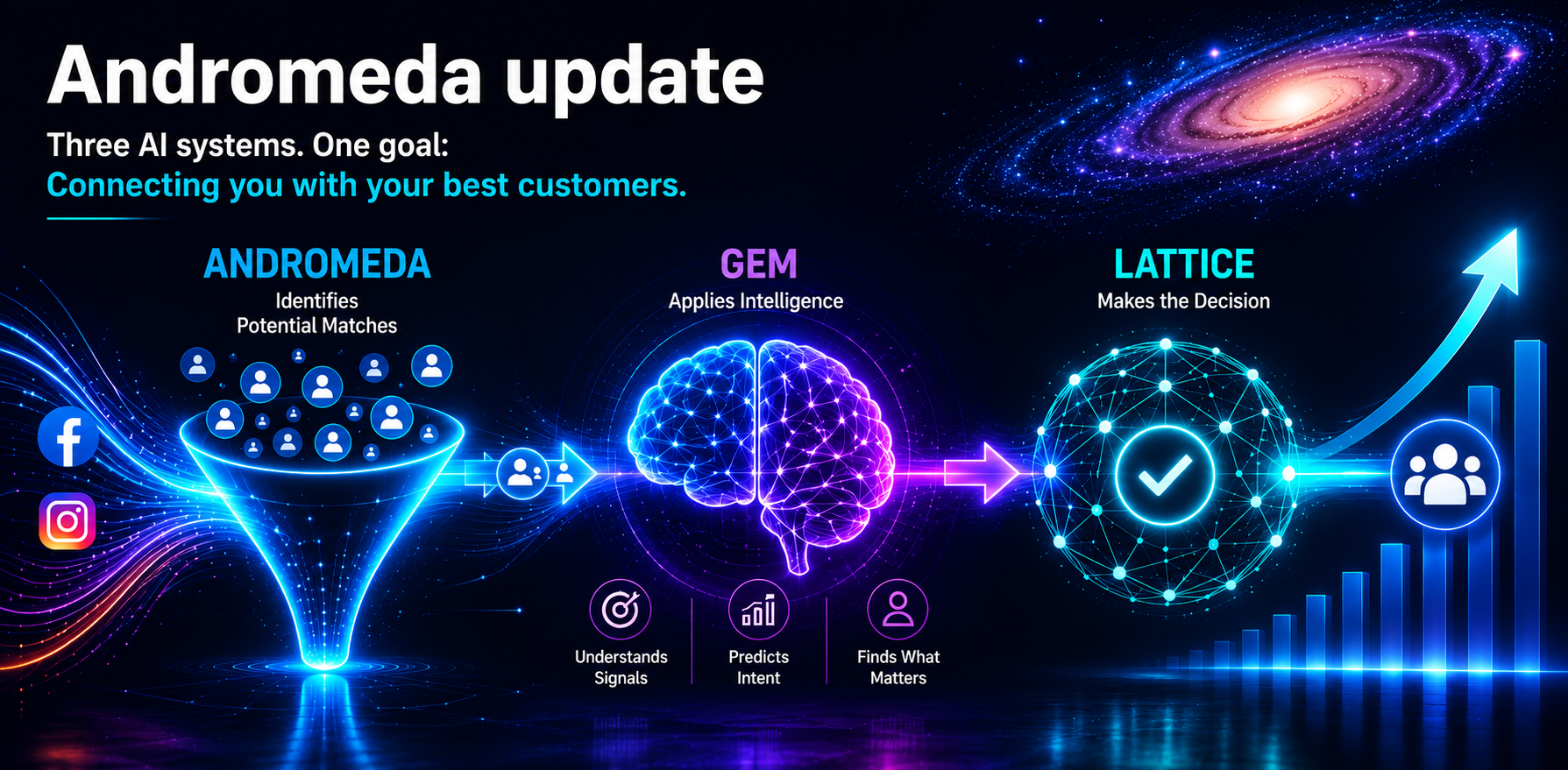
Think of it this way. Every time someone opens Facebook or Instagram, Meta has millions of ads from thousands of brands competing for that moment. Andromeda's job is to narrow that down quickly. It acts like a smart filter, pulling together a relevant pool of ads that could potentially work for that specific person. That’s all it does. It does not pick any winning ad.
That is where GEM comes in.
GEM stands for Generative Ads Model, and this is the part people are calling the super brain… and for good reason. Once Andromeda has created this shortlist, GEM goes to work analysing it at a much deeper level. It is not just looking at basic interests or demographics. It is processing detailed behavioural signals, understanding patterns, and essentially predicting what a person is likely to want or do next, sometimes before they even know themselves. It takes Andromeda's broad pool and narrows it down further using a level of intelligence that no manual targeting setup could ever replicate.
And then Lattice makes the final call.
Lattice is best described as the central nervous system that holds everything together. It is a unified library of all of Meta's AI models, and GEM actually lives inside it. In the past, Meta's different prediction models operated separately. This is partly why strategies like interest targeting, lookalike audiences and splitting prospecting from retargeting, had value. You were essentially helping a fragmented system connect the dots.
Lattice changed that. Everything now works together in one place, and it is Lattice that selects the final ad shown to each individual person.
So to put it simply: Andromeda finds the candidates, GEM applies the intelligence, and Lattice makes the decision.
What mistake are most advertisers still making?
Here is a pattern that became very common. Upload an ad, duplicate it, maybe pair it with a variation, and let the algorithm optimise between them. Simple enough.
The issue is when you are only testing similar ads against each other, you are giving Meta a narrow range of signals to work with. The algorithm does not have enough creative diversity to find different types of buyers. It keeps reaching the same people, and over time, performance plateaus or drops entirely.
This is what caught so many advertisers off guard. Ads that were performing well simply stopped delivering.
So what’s actually working now?
The shift this system demands is not complicated, but it does require a different mindset.
Meta wants to find your buyers. Your job is to give it enough signals to work with.
This practically means that a few things have changed:
Broad or Advantage+ audiences now outperform tightly stacked interest targeting in most cases. Rather than telling Meta who to target, you let the algorithm figure it out, and it is genuinely good at it, provided the signals are strong enough.
Creative diversity is no longer optional. Even if your product or service stays the same, you need to be testing different angles, different messages, different ways of framing what you offer. One angle speaks to the problem. Another speaks to the outcome. Another builds trust. The more variety you give the system, the better it can match the right message to the right person.
Fewer campaigns with more creative variations inside them, tend to perform better than spreading budget thin across multiple ad sets. The algorithm needs enough data to optimise, and splitting budgets in too many ways starves it.
The part most people overlook.
None of this works as well as it should without clean conversion data. The optimisation across all three systems depends entirely on the signals you feed back into Meta. If a significant portion of your conversions are going untracked because of ad blockers or iOS privacy restrictions, the algorithm is learning from an incomplete picture. Broad audiences will not perform the way they should because Meta is essentially navigating with gaps in the map.
Getting your tracking right is not a technical afterthought.
It is the foundation the whole strategy depends on.
Going forward, what does this actually mean?
The honest truth is that Andromeda, GEM, and Lattice did not kill your results. What they did was raise the bar. Advertisers who responded by sharpening their creative strategy, diversifying their angles, and feeding the algorithm better signals are seeing stronger results than ever. The ones still running the same playbook from a few years ago are the ones feeling the pinch.
The gap between organic and paid content is also closing faster than most people realise. Brands that are producing genuine, varied content consistently are going to be in the strongest position going forward, because that same creative engine feeds both.
Test more angles. Broaden your audiences. Consolidate your budget. Fix your tracking. Give Meta the creative variety and conversion signals it needs, and let it do what it is genuinely built to do.
If your Meta ads have been underperforming and you are not sure where the problem sits, whether it is your creative strategy, your audience setup, or your tracking, that is exactly what we help businesses work through.
3Pandas Marketing Solutions
